Electroslag Welding(ESW)Technology
Order
Electroslag Welding(ESW)Technology
Electroslag Welding (ESW) is one of the most efficient welding methods for joining very thick steel components in a single vertical pass. Developed specifically for heavy industrial fabrication, ESW is widely used in industries where large steel structures require strong, reliable, and economical welds.
Unlike conventional welding processes that rely on an electric arc throughout the entire operation, Electroslag Welding primarily generates heat through the electrical resistance of molten slag. This unique process enables manufacturers to produce high-quality welds with excellent mechanical properties while significantly reducing production time.
As industries continue to demand larger fabricated structures, ESW has become an important technology in sectors such as bridge construction, shipbuilding, pressure vessel manufacturing, power generation, heavy machinery, and steel fabrication.
What Is Electroslag Welding?
Electroslag Welding (ESW) is a single-pass vertical welding process used to join thick metal plates, typically ranging from 25 mm to over 300 mm in thickness.
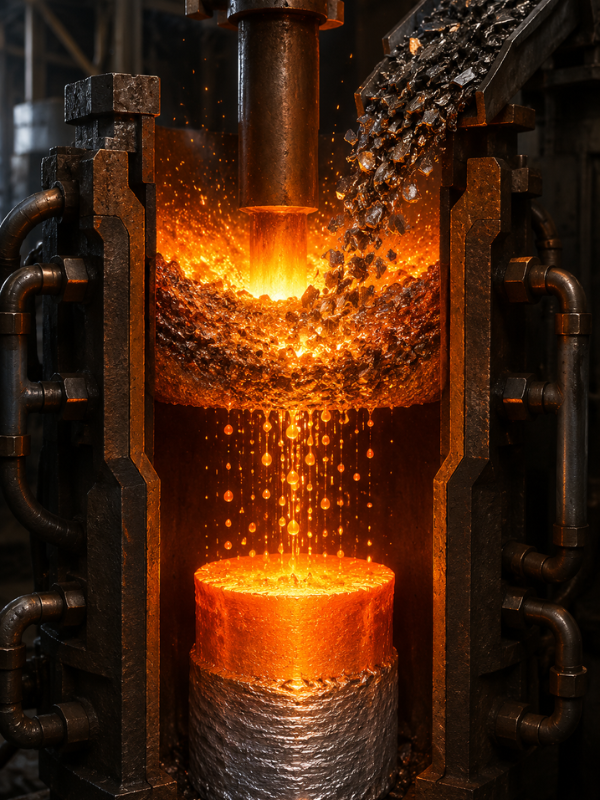
The welding operation begins with an electric arc between the consumable electrode and the workpiece. Shortly afterward, specially formulated welding flux melts into conductive molten slag. Once sufficient slag has formed, the arc is extinguished, and electrical current flows through the molten slag.
As electric current passes through the molten slag, its resistance produces the thermal energy required to liquefy both the consumable electrode and the adjoining edges of the steel plates, allowing them to fuse into a solid weld. As the weld solidifies from the bottom upward, copper shoes on both sides contain the molten metal and create a smooth weld surface.
The result is a dense, continuous weld that extends through the full thickness of the material without requiring multiple passes.
How Electroslag Welding Works?
The ESW process follows several important stages:
1. Joint Preparation
The steel plates are positioned vertically with a controlled gap between them. Water-cooled copper shoes are attached to both sides of the joint to contain the molten weld pool.
2. Arc Initiation
An electric arc is struck using a consumable wire electrode to melt the welding flux.
3. Formation of Molten Slag
The flux transforms into electrically conductive molten slag.
4. Resistance Heating
After the slag becomes conductive, the electric arc disappears. Heat is now produced by the electrical resistance of the molten slag.
5. Continuous Welding
The consumable electrode continuously feeds into the weld pool while the entire welding assembly gradually moves upward.
6. Weld Solidification
As welding progresses, the molten metal solidifies beneath the slag, creating a strong and homogeneous weld.
Main Components of an ESW System
An Electroslag Welding system generally includes:
– Welding power source
– Consumable wire electrode
– Wire feeder
– Welding flux
– Water-cooled copper shoes
– Guide tube
– Vertical travel mechanism
– Control system
– Workpiece fixtures
Each component contributes to maintaining process stability and ensuring consistent weld quality.
Advantages of Electroslag Welding
Electroslag Welding offers many significant advantages over conventional welding methods.
Exceptional Productivity
One of ESW’s greatest strengths is its ability to weld thick plates in a single pass, dramatically reducing fabrication time.
High Deposition Rate
The continuous wire feed allows extremely high metal deposition rates, making ESW highly productive.
Reduced Labor Costs
Since only one welding pass is required, fewer operator hours are needed.
Excellent Weld Quality
Properly controlled ESW produces:
– High structural integrity
– Low defect rates
– Full penetration
– Uniform weld profile
– Low Material Distortion
Although heat input is high, the controlled vertical process helps minimize distortion in many large structures.
Ideal for Thick Sections
Traditional welding may require dozens of passes for very thick plates, whereas ESW can complete the joint in one continuous operation.
Limitations of Electroslag Welding
Although ESW offers many benefits, it also has certain limitations.
Vertical Position Only
The process is designed exclusively for vertical welding.
Thick Materials Required
ESW is generally unsuitable for thin plates because of its high heat input.
Specialized Equipment
Dedicated machinery and precise control systems are required.
Joint Accessibility
Adequate access is needed for installing copper shoes and welding equipment.
High Heat Input
Improper parameter selection may affect the heat-affected zone and mechanical properties.
Materials Suitable for ESW
Electroslag Welding is commonly used for:
– Carbon steel
– Low-alloy steel
– Structural steel
– High-strength steel
– Certain stainless steels
– Heavy engineering steels
The suitability depends on material composition and welding procedure specifications.
Typical Plate Thickness
Electroslag Welding is generally applied to materials between:
25 mm
40 mm
60 mm
100 mm
150 mm
200 mm
300 mm
Even thicker custom sections
Large industrial fabrications frequently involve components exceeding 250 mm in thickness.
Industries That Use Electroslag Welding
ESW plays a critical role across many industries.
Heavy Steel Construction
Large building columns, structural supports, and heavy frameworks benefit from ESW’s speed and strength.
Bridge Manufacturing
Massive bridge sections often contain thick steel plates that are ideal for Electroslag Welding.
Shipbuilding
Large ship hull sections require strong vertical welds capable of withstanding heavy mechanical loads.
Pressure Vessel Manufacturing
Industrial pressure vessels and reactors frequently incorporate ESW for joining thick shells.
Hydroelectric Projects
Turbine housings, gates, and structural supports often utilize Electroslag Welding.
Nuclear Industry
Certain heavy nuclear components are fabricated using carefully qualified ESW procedures.
Mining Equipment
Excavators, crushers, loaders, and dragline components often include ESW joints.
Steel Mills
Large rolling mill equipment and heavy industrial frames commonly employ Electroslag Welding.
Comparison with Other Welding Processes
| Welding Process | Best For | Number of Passes |
|---|---|---|
| Electroslag Welding | Very thick vertical joints | Usually one |
| Submerged Arc Welding | Long horizontal welds | Multiple |
| MIG Welding | Medium thickness | Multiple |
| TIG Welding | Precision applications | Multiple |
| Shielded Metal Arc Welding | Repair and maintenance | Multiple |
Each welding method has its own advantages depending on material thickness, joint design, and production requirements.
Weld Quality in ESW
High-quality Electroslag Welding depends on:
– Proper joint preparation
– Correct welding parameters
– Suitable flux selection
– Stable wire feed
– Controlled travel speed
– Effective cooling of copper shoes
– Qualified welding operators
When these factors are maintained, ESW can produce welds with excellent strength and reliability.
Safety Considerations
Because Electroslag Welding operates at extremely high temperatures, strict safety measures are essential.
Operators should use:
– Heat-resistant protective clothing
– Welding helmets
– Face shields
– Protective gloves
– Safety footwear
– Proper ventilation systems
– Electrical safety procedures
Regular equipment inspection also helps maintain safe operation.
Future of Electroslag Welding
Modern manufacturing continues to improve ESW through automation and digital process control.
Current innovations include:
– Robotic welding systems
– Computer-controlled welding parameters
– Real-time monitoring
– Automated wire feeding
– Digital quality inspection
– Smart manufacturing integration
– Industrial data analytics
These advancements improve consistency, productivity, and weld quality while reducing operator intervention.
Why Manufacturers Choose Electroslag Welding?
Manufacturers select ESW because it provides:
– Faster production
– Strong, full-penetration welds
– Reduced welding time
– Lower labor requirements
– High productivity
– Reliable mechanical performance
– Cost-effective fabrication of thick steel structures
For industries producing heavy steel components, Electroslag Welding remains one of the most efficient joining technologies available.
Electroslag Welding (ESW) is an advanced welding process specifically developed for joining thick steel plates in a single vertical pass. By generating heat through electrically conductive molten slag rather than maintaining a continuous welding arc, ESW delivers exceptional productivity, high-quality welds, and significant cost savings for heavy fabrication projects.
From bridge construction and shipbuilding to pressure vessels, mining equipment, and power generation, ESW continues to play a vital role in modern industrial manufacturing. As automation, digital monitoring, and intelligent process control continue to evolve, Electroslag Welding is expected to remain one of the leading technologies for large-scale steel fabrication, helping manufacturers achieve stronger welds, faster production cycles, and greater overall efficiency.
Subscribe For 10% Off
ТЕЛ (050) 320-00-24
ТЕЛ (063) 930-47-56